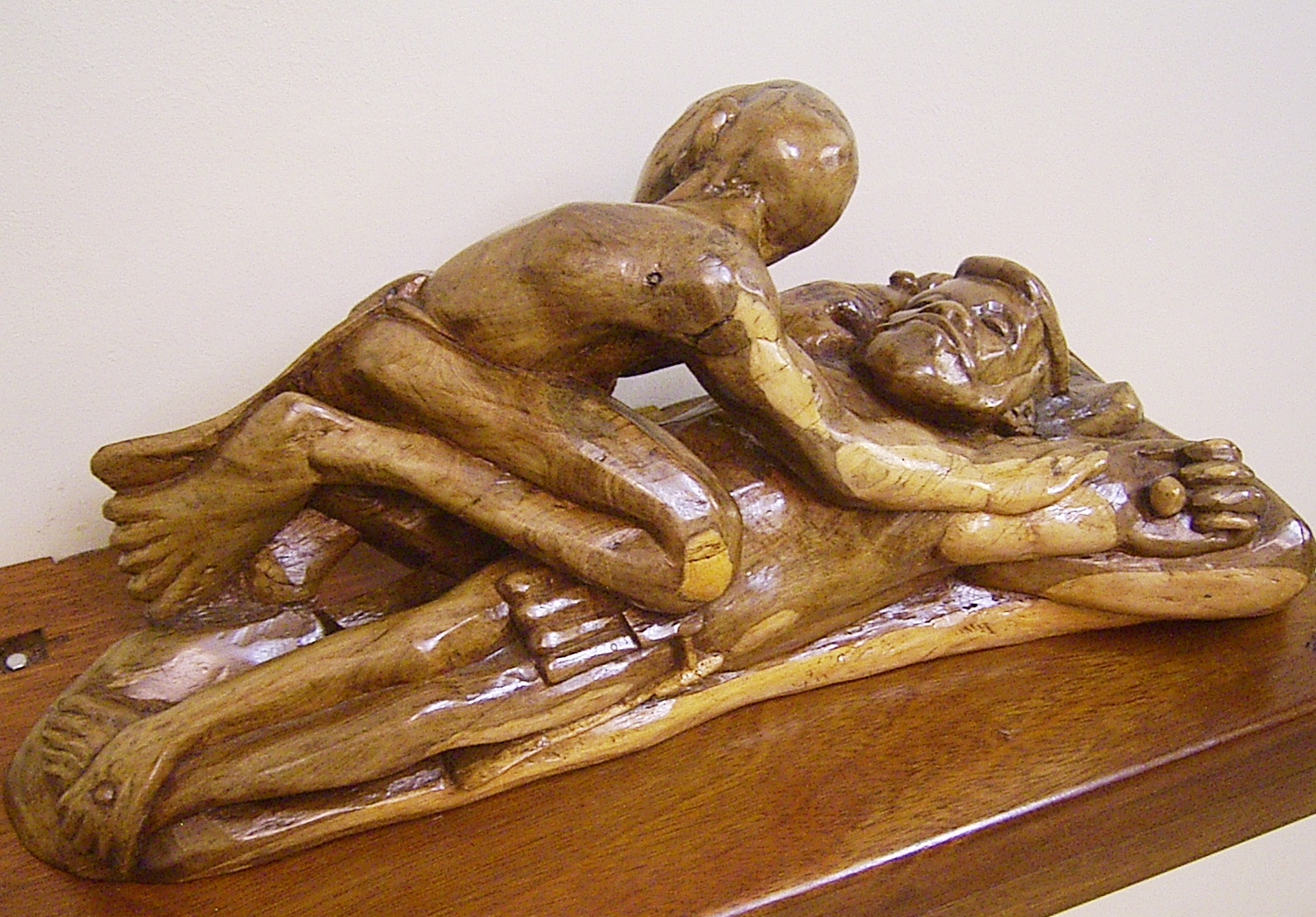
The passage of our hospice is lined with Stations of the Cross hand-carved from thombothi wood by the Zulu artist Joel Mbuyisa. With these, we wish to express that we encounter Christ in the people we are privileged to accompany on their way of the cross, for he said: "Whatever you did for one of the least of these brothers and sisters of mine, you did for me." (Matthew 25:40)
Just as Veronica offered Christ the sweat cloth, so we too encounter the suffering Servant of God, Christ, in the seriously ill, and – as Blessed Gérard said – we want to work (like Veronica) to lessen this suffering and make this misery more bearable.
Just as Simon of Cyrene took the cross of Christ upon his own shoulders, so we too want to help the dying bear their cross as we accompany them on their journey to death.
Every day, we are bombarded with new horrific reports about the wars in the Holy Land, Ukraine, and many other countries. God's will is that every human being have life in abundance (John 10:10), but life is being destroyed en masse by an ever-more perfected war machinery.
The crucifixion scene depicted above comes to mind. Christ, the author of life, through whom everything was created, indeed, who is life himself (John 14:6), is murdered in the most gruesome way. Although Christ has already been crucified and, so to speak, can no longer run away, his tormentor still holds him by the arms, kneels on his waist, and doesn't even look at him.
When God gave us the breath of life at our creation, he gave us a share in himself; indeed, he made us little less than himself (Psalm 8:6). This likeness of God is our greatest human dignity. It consists in the fact that we can receive life and love and give life and love, or, in plain language, that we can, may, and even should receive God and donate God.
Whoever destroys life and turns away from love crucifies Christ, love and life. And then the Crucified One says the unspeakable about his crucifiers: "Father, forgive them, for they know not what they do!" (Luke 23:34)
In his death, Christ entered the realm of death, and because love never ends (1 Corinthians 13:8), he—who is not bound to the earthly dimensions of time and space—takes with him all who have ever died, all who are dying now, and all who will die in the future, in his resurrection from the dead, and gives them new life. In my eyes, the most joyful Easter message for us is: "You have been raised with Christ." (Col. 3:1)
This new and eternal life was given to us in our baptism. But because our sinfulness repeatedly turns us away from God's life-giving and life-sustaining love throughout our lives, Christ continually offers us reconciliation. The Risen One met the apostles and said, "Whose sins you forgive, they are forgiven them." (John 20:23)
My wish for all of us at Easter: Let us turn away from everything that endangers life and love. Let us turn to God, the epitome of life and love. Let us be reconciled with God and live as God's image by understanding our life as a gift of his love and by passing on Christ, who is love and life, through our concern for life and through our love.
So I remain with warm greetings and best wishes for a blessed Lent and a happy Easter.
Yours confraternally
PS 1: Our current activity report for 2024 is now available online here.
PS 2: Our Stations of the Cross are available online here as the Stations of the Cross meditation "The Way of Love."
PS 3: My South African WhatsApp was "hacked" on 26 March 2025, meaning I lost control of my WhatsApp account, and a "hacker" then sent messages to many of my contacts asking them to transfer money to an account, for example, in Lithuania or Spain, and I would refund the transferred money to the respective contact the following day.
I hope no one transferred any funds. I'm very embarrassed about all of this, but the "hacker" is the scammer.
WhatsApp has since restored my South African account, and now I'm the one using it again.
Father Gérard T. Lagleder O.S.B.
President
Brotherhood of Blessed GérardP O Box 440Mandeni 4490Republic of South Africa
Father@bbg.org.zahttp://bbg.org.za